Nexus Market Link and Tor URL Verification
Before you trust any Nexus onion link claiming to point at darknet infrastructure, stop and verify. NexusWatch documents the current Nexus Market link and Tor URL as a cryptographic research record: each entry in our registry is anchored to a PGP signature, cross-referenced against the operator's most recent canary statement, and stamped with the date our automated checks last confirmed the endpoint was reachable. We do not host the marketplace, we do not endorse what happens on it, and we do not publish addresses we cannot validate cryptographically.
-
Primary Endpoint
nexusck4c5hrdikdhoyh5jxuxzrcm2cfqlk5saqwdkdosu7irbraqgyd.onion -
Mirror 1
nexusc4fexvg56avvkne2qgmgseaq3inndfwrtdtoz3jwl7hdfqx5dad.onion -
Mirror 2
nexuseuszbyooiqnpmstgtzssbcftr43yoj6e3yuo3nrqk7gsipdfead.onion

Nexus Market Link and Nexus Onion Link Registry
The three records shown above represent the Nexus Market link and the Nexus Market URL currently held in our verification registry. Each entry is documented as a research artefact, plain text, with no embedded redirects and no clickable wrappers, so that researchers and Tor users can confirm a Nexus Market link against an independent source before connecting through their own circuit. The primary endpoint is the operator's main hidden service descriptor; the two mirrors are alternative routing endpoints attested by the same PGP signing key, intended for use when the primary endpoint is degraded or unreachable. Independent cryptographic verification using your own PGP keyring is strongly recommended before connecting to any address documented above. The registry is the inline reference for everything in the rest of this page; the methodology and lifecycle sections that follow explain the validation discipline behind every entry.
Nexus Tor URL Verification Methodology
Every Nexus Market link and Nexus Market URL we publish goes through a two-stage validation cycle before it lands in the registry above. The first stage proves the address belongs to the operator who has historically signed for Nexus Market. The second stage proves the endpoint behind that address still behaves the way the operator's canary said it would. Either stage failing pulls the Nexus Market link from the registry until the discrepancy is explained or replaced.
PGP Signature Validation
The operator behind Nexus Market publishes a signed canary on a public schedule using a long-lived PGP signing key. We pull that canary, verify the PGP signature against the keyring we have built up across multiple releases, and check that the canary mentions the new Nexus Market URL by its full onion fingerprint, not just by handle and not just by mirror designation. A canary that signs for the wrong fingerprint is treated the same as no canary at all: the Nexus Market link does not enter the registry. We retain the previous signing key on file for at least one full rotation cycle so that key transitions can be audited rather than assumed, which is also how a legitimate operator key change becomes distinguishable from an unverified copy claiming the same identity.
Endpoint Integrity Checks
Once PGP signature validation has cleared, the Nexus Market URL enters a one-week observation window. Our monitoring infrastructure connects through fresh Tor circuits at staggered intervals and records response headers, the endpoint fingerprint exposed over the hidden service descriptor, and any anomalies in the routing path. An endpoint that drops out of the consensus, returns inconsistent descriptors, or starts presenting a different fingerprint to different circuits is flagged and removed from the registry pending operator clarification. The Nexus Market URL is listed only after it has held a stable response signature across the full observation window. The same standard applies to the Nexus Market link: no shortcuts, no provisional listings.
Nexus Onion Link Lifecycle and Rotation
Nexus onion addresses are not permanent. Operators rotate them deliberately, sometimes to retire a fingerprint that has been targeted by sustained traffic analysis, sometimes to migrate the hidden service to new infrastructure, sometimes because the previous descriptor was burning through introduction points faster than expected. None of those transitions are visible to the user landing on a stale address, which is why a Nexus onion address that worked last month is not, by itself, evidence that it is the current Nexus onion address today. The Nexus Market link in the registry above reflects the current generation; everything before it lives in our deprecated archive.
Our lifecycle tracking treats each Nexus onion URL as a record with provenance: when we first observed it, which signed canary attested to it, what the endpoint's response signature looked like across the observation window, and the date a successor address replaced it. Old records do not vanish. They move to a deprecated state with a pointer forward to the address that succeeded them. That history is what lets researchers tell the difference between an operator-driven rotation and a lookalike registration trying to step into the gap during a rotation window.
Nexus Tor URL Endpoint Monitoring
The Nexus Tor footprint is monitored on a six-hour cycle. Every cycle, our infrastructure rebuilds Tor circuits from a clean state, opens a hidden service descriptor lookup against the Nexus Tor address held in the registry, and records the round-trip latency, the introduction point set, and the descriptor publication time. Latency drift outside the observed baseline triggers a manual review; descriptor churn inside a single cycle escalates to a full re-validation of the Nexus Market link. The cycle is short enough that a Nexus Tor outage shows up in our logs within hours, not days, and long enough that we are not generating circuit load purely for its own sake.
Nexus Darknet Context and History
Nexus is one of several darknet marketplaces that emerged in the post-2023 reshuffle following the closure of larger predecessors, and it has held a measurable share of the English-language Tor commerce ecosystem since then. Independent researchers tracking the Nexus darknet market have documented its internal architecture, its escrow model, and its operator's stated security posture across forum disclosures and public canary statements. The Nexus darknet footprint is not enormous in absolute terms, but it is consistent enough across observation cycles that lifecycle tracking produces useful longitudinal data. NexusWatch does not extend or contradict the operator's claims. We document them, timestamp them, and tie them back to the Nexus Market link addresses we have been able to verify cryptographically.
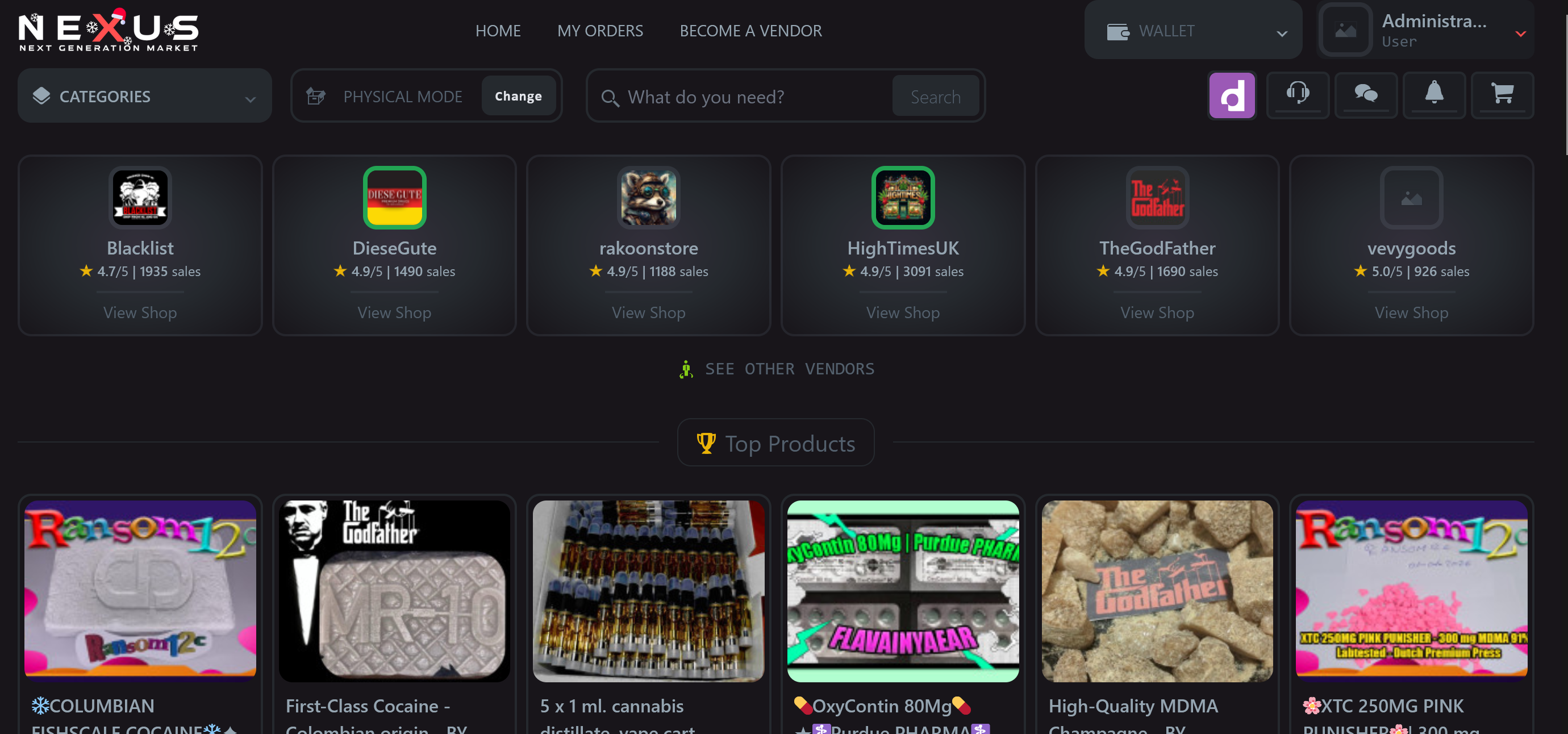
This editorial position is deliberate. A directory that advocates for a Nexus darknet market becomes part of that marketplace's reputation surface. A registry that simply documents what is verifiable does not. Researchers looking for Nexus market access points who need to know whether a given address belongs to the Nexus darknet operation they are searching for are better served by the second posture, and that is the one this site is built around. In 2026, with the Nexus Market 2026 generation of addresses now in active rotation, the documentation discipline matters more than at any prior point in the project's history. The same discipline applies whether the immediate question is about Nexus access from a fresh circuit, about lifecycle attribution after a rotation, or about historical attestation for a deprecated entry.
Nexus Onion Link Operational Notes
If you are about to connect to the Nexus onion site listed in the registry, treat that connection as you would any other security-sensitive Tor session. Open a fresh Tor Browser session with no leftover state from clearnet browsing. Pull the onion fingerprint from this page using a connection you trust, compare it character by character against the fingerprint signed in the operator's most recent canary, and only then construct the address in your address bar. Nexus access from a stale browser profile is the most common way researchers end up looking at a lookalike instead of the registered endpoint, and it is preventable with a single fresh session. The Nexus onion site is not the place for shortcuts: a single mistyped character can route you into a lookalike registration, and your credentials end up somewhere they were never supposed to be. The same discipline applies whether you are looking up the Nexus onion site, the Nexus Market URL, or the long-form Nexus onion url that researchers occasionally reference in academic write-ups.
Frequently Asked Questions
What does NexusWatch actually do?
NexusWatch maintains a verified registry of the Nexus Market link and Nexus Market URL, anchored to the operator's PGP-signed canary statements and corroborated by automated endpoint monitoring. We document. We do not host, broker, or facilitate marketplace activity, and we do not act on behalf of the operator.
When does a Nexus Market link enter the public registry?
A Nexus Market link only enters the public registry after PGP signature validation and the full one-week endpoint observation window have both completed. The verification record remains documented with its validation date, signing evidence, and endpoint review notes so researchers can audit the listing independently.
How often is the Nexus Market URL re-checked?
Once the Nexus Market URL has cleared the initial validation cycle, our monitoring infrastructure re-checks it on a six-hour observation interval. Any change in descriptor, response fingerprint, or canary state pulls the record into manual review and freezes its status until the question is resolved.
Do you publish historical Nexus onion addresses?
Yes. The lifecycle records for previous Nexus onion address generations remain in our archive in a deprecated state, each with a pointer forward to the Nexus Market link that replaced it. That archive is what lets researchers distinguish operator-driven rotation from lookalike registration after the fact, and it is also where Nexus market verification audits begin.
Is the Nexus Tor address the same as the Nexus onion address?
Functionally, yes. "Nexus Tor" and "Nexus onion address" both refer to the same hidden service descriptor in the Tor network. The two phrasings are used interchangeably in practice; this site uses both because researchers and users search for them with both wordings and the registry has to be reachable either way.
What happens if the operator's canary goes silent?
A silent canary triggers an automatic registry pause. The current Nexus Market link is held at its existing status until the canary returns or until alternative cryptographic attestation arrives. If neither materialises within our defined window, the record is moved to a deprecated state with a public note explaining why.
Can I use this registry to access Nexus services?
The registry is informational. Researchers referencing the documented Nexus access points are responsible for their own connection decisions, their own legal compliance, and their own operational security. NexusWatch is a research record, not a connection broker, and the Nexus market access decisions you make remain yours.
Why is this site called NexusWatch instead of Nexus Market?
Because we are not Nexus Market. NexusWatch is an independent research project that documents Nexus Market addresses without representing or speaking for the marketplace. That separation is editorial, legal, and technical. The research disclaimer carries the full position statement; the short version is that documenting an address is not the same as endorsing what is reachable through it.
Primary sources and further reading
The verification framework described on this page is anchored to published protocol specifications and reference implementations. The entries below are the primary documents a researcher would consult to audit our methodology independently.
- Tor Project. Tor Rendezvous Specification — Version 3. Onion service descriptor format, address construction, and key rotation model. spec.torproject.org/rend-spec
- Appelbaum, J.; Muffett, A. RFC 7686 — The “.onion” Special-Use Domain Name. IETF, October 2015. Formal reservation of the
.onionTLD. rfc-editor.org/rfc/rfc7686 - Callas, J.; Donnerhacke, L.; Finney, H.; Shaw, D.; Thayer, R. RFC 4880 — OpenPGP Message Format. IETF, November 2007. Canonical reference for the signature validation discipline applied to the operator canary. rfc-editor.org/rfc/rfc4880
- The GnuPG Project. The GNU Privacy Handbook. Reference implementation used for signature verification against the keyring we maintain. gnupg.org/documentation
- Dingledine, R.; Mathewson, N.; Syverson, P. Tor: The Second-Generation Onion Router. USENIX Security Symposium, 2004. Original Tor design paper underpinning the hidden service descriptor model. torproject.org/design-paper